
Other Terms
Other Terms
Use the menu on the left to explore.
Beatitudes
the title given to Matthew 5:3-12
the beginning of the Sermon on the Mount
Blessed are the poor in spirit, for theirs is the kingdom of heaven.
Blessed are those who mourn, for they will be comforted.
Blessed are the meek, for they will inherit the earth.
Blessed are those who hunger and thirst for righteousness, for
they will be filled.
Blessed are the merciful, for they will be shown mercy.
Blessed are the pure in heart, for they will see God.
Blessed are the peacemakers, for they will be called children of
God.
Blessed are those who are persecuted because of righteousness,
for theirs is the kingdom of heaven.
Blessed are you when people insult you, persecute you and falsely
say all kinds of evil against you because of me.
Rejoice and be glad, because great is your reward in heaven, for in
the same way they persecuted the prophets who were before you.

Carl Bloch, Sermon on the Mount, 1877
Allatoona Pass
October 5, 1864
After Union general William Sherman burned a swath across the south and took control of Atlanta on September 6, 1864, Confederate forces were depleted, and morale was low. Confederate general John Bell Hood knew he didn't have the numbers or strength to defeat Sherman and retake Atlanta, so Hood devised a plan to attack the Union's railway supply lines to lure Sherman out of the city. Jefferson Davis, President of the Confederacy, traveled to Georgia to personally review and approve Hood's plans. His speech from September 27 was reprinted as a battle cryacross the South:
Our cause is not lost. Sherman cannot keep up his long line of communications; retreat sooner or later he must… When that day comes, the fate that befell the army of the French in its retreat from Moscow will be reenacted…
Forewarned, Sherman planned to move out of Atlanta to preempt Hood's siege. Over several days in late September and early October, Sherman and Hood tried to outflank each other, until Sherman holed up at the old mining town of Allatoona. On October 5, 1864, Southern and Northern armies clashed from 9am until 1pm. The Union forces outlasted the Confederacy - to their embarrassment.
Solid shot and shells, grape and canister from double shotted cannon and a hailstorm of bullets were rapidly and accurately poured into the ranks of the Confederates as they recklessly advanced. And yet, not withstanding their fearful losses at every step, they still advanced… The spectacle was sublime.
- a Union soldier at Allatoona


Cappadocia
cap-puh-doh-sha
Historical region that lies in the center of present-day Turkey. The Kingdom of Cappadocia warred with Greece and Rome for centuries until it became a Roman province in the first century CE, but it was still considered a frontier. perhaps most famously, Cappadocia is named in Acts 2:9 as one of the regions whose people's comprehension transcended normal hearing:
Now there were staying in Jerusalem God-fearing Jews from every nation under heaven. When they heard this sound, [of the Apostles receiving the Holy Spirit], a crowd came together in bewilderment, because each one heard their own language being spoken. Utterly amazed, they asked: “Aren’t all these who are speaking Galileans? Then how is it that each of us hears them in our native language? Parthians, Medes and Elamites; residents of Mesopotamia, Judea and Cappadocia, Pontus and Asia, Phrygia and Pamphylia, Egypt and the parts of Libya near Cyrene; visitors from Rome (both Jews and converts to Judaism); Cretans and Arabs—we hear them declaring the wonders of God in our own tongues!”

Ethel Merman
1930-1982
First Lady of the American Musical
Merman is a Broadway legend, known for her brassy belt and starring roles in the premieres of Anything Goes, Annie Get Your Gun, and especially Gypsy.

Merman as Reno Sweeney in Anything Goes (1954).
The Garden of Gethsemane
Gethsemane was a garden on the eastern side of Jerusalem where, according to various New Testament accounts, Jesus prayed on the night before the Crucifixion. Etymology suggests it was a grove of olive trees (hence Monica’s taunts on page 18).
According to the Gospel of Matthew, Jesus hosted the Last Supper, at which he declared one of the apostles would betray him; afterward:
Then Jesus went with his disciples to a place called Gethsemane, and he said to them, “Sit here while I go over there and pray… My soul is overwhelmed with sorrow to the point of death. Stay here and keep watch with me.” Going a little farther, he fell with his face to the ground and prayed, “My Father, if it is possible, may this cup be taken from me. Yet not as I will, but as you will…” [Jesus] He went away a second time and prayed, “My Father, if it is not possible for this cup to be taken away unless I drink it, may your will be done.”
-Matthew 26:36-45
Soon after, Judas arrives with an armed group to arrest Jesus, following Caiaphas’ orders.

Carl Bloch, Jesus in Gethsemane, 1873
Benedict Arnold
1741-1801
Born in Connecticut, Benedict Arnold was an apothecary apprentice and enlisted in the militia during the Seven Years (or French and Indian) War (1754 - 1763). He was a prosperous ship trader and joined the Continental Army in 1775. George Washington appointed him to lead an expedition to Quebec to gather allies and break the military hold that Britain had on Canada. They lost the battle, and Arnold was severely wounded. He was promoted to brigadier general but was despised by his fellow officers due to his “rash courage and impatient energy.” When he was passed over in 1777 for promotion, he considered resigning but was severely wounded again in the Battle of Saratoga. Arnold was then left in command of Philadelphia, where he broke several military and state regulations due to embezzlement charges.

1776 Portrait by Thomas Hart
Treason
While in Philadelphia Arnold married Peggy Shippen, the daughter of a powerful man with Loyalist (British-supporting) sympathies. Arnold had five children with Shippen (adding to the three he had with this first wife) and accumulated severe debt. Suspected of embezzlement, crushed under unresolved debt, and frustrated over his failure to be promoted, Arnold began secretly working for the British army. By the end of 1779, Arnold worked with British forces to capture Fort West Point, when his British contact was captured -- with papers stuffed in his boots that implicated Arnold’ Arnold fled behind British lines before being captured and court-martialed. He was allowed live after George Washington was convinced an execution would turn Arnold into a martyr for the British. At the British surrender at Yorktown, Arnold was burned in effigy. Following his death in London in 1801, at the age of 60, he was buried without military honors, and his name has become synonymous with “traitor” in American pop culture and colloquially.
Don Ho
1930-2007
legendary Hawaiian musician
I
-
A Native Hawaiian, his music was discovered in his mother’s local Tiki bar
-
Integral part of attracting tourism to the newly admitted state at the time
-
Music peaked in the mid-late 1960s era
-
Made many guest appearances on popular TV shows of the time, including "The Brady Bunch," "I Dream of Jeannie," "Batman," "Charlie’s Angels," "McCloud," "Fantasy Island," and "Sanford and Son"
-
Hosted "The Don Ho Show," a variety show, from October 1967-March 1977
-
Married twice with ten children
-
Suffered several illnesses starting in 1995: a mild stroke, cardiomegaly, cardiomyopathy, and severe pacemaker malfunction ultimately leaving him with 30% cardiac capacity of his heart by 2002
François Duvalier, "Papa Doc"
1907-1971
Haitian dictator
Born in Port-au-Prince, Haiti, Duvalier graduated from the University of Haiti School of Medicine in 1934 and became an avid contributor to an anti-American occupation and black nationalist newspaper known as the Action Nationale. During these years, he became politically active and co-founded Le Groupe des Griots, a circle of writers who embraced traditional Négritude values (black-French nationalism); they wrote for the black lower and middle classes to overthrow the mixed-European elite. Duvalier was a supporter of President Dumarsai Estimé and was apponted director general of the National Public Health Service. During this time, despite his views on US imperialism and occupation, he was the director of several US sponsored campaigns against malaria and yaws (a contagious tropical disease that can cause skin lesions and ulcers) throughout the 1940s. When President Estimé was overthrown in a coup in 1950, Colonel Paul Magloire became President and Duvalier went underground. Riots forced Magloire to resign from the Presidency in 1956, and Duvalier came out of hiding to run for the presidency on a platform of black nationalism and popular reform. He won in 1957, some sources say the election was rigged by his underground followers.

Crimes and Legacy
Within months of winning the presidency, Duvalier distributed “self-promoting propaganda” and organized a private police force known as the Tontons Macoutes (the “Bogeyman”), charged with for silencing signs of oppression using terror, extortion, and murder. Duvalier prevented a coup in 1958 and survived a heart attack in 1959, both of which contributed to his heightened paranoia.
He manipulated the legislature to have his presidency term extended from four years to a lifelong occupation in 1964. Professionals began to flee from Haiti, resulting in the crashing of economic, educational and health systems. Malnutrition and famine became endemic to the country, while Duvalier’s government stole about $500 million in taxes and foreign aid, leaving the country with few allies. His corruption killed around 30,000 Haitians due to food shortages, assault, and muder by the Tontons Macoutes and Duvalier’s government.
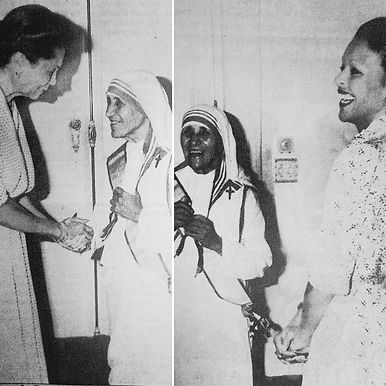
Duvalier stayed in control of the Haitian government longer than any of his predecessors, until 1971 when power was transferred to his son, Jean-Claude Duvalier (known as “Baby Doc”). Despite UN accusations of crimes against humanity, Mother Teresa (pictured below with the Duvaliers) had a strong friendship with Baby Doc and his wife, accepting donations from them and commenting that visiting the country and seeing the relation between the poor and the government was a “beautiful lesson” for her.
WH Auden
1907 - 1973
one of the 20th century’s most influential poets
Wystan Hugh Auden was raised in Birmingham, England by two devout Anglican parents. Though he discovered he wanted to be a poet at age 15 (and quickly lost his religious beliefs), Auden eventually went to Oxford to study natural science. After switching to philosophy, politics, and economics, Auden ultimately found himself studying English after being unable to stay away from the TS Eliot. His interest in the scientific world and knowledge of it were not lost, and much of his poetry contains scientific overtones, as does the writing itself with its focus on order and truth.

At Oxford, Auden led the “Oxford Group,” sometimes known as the “Auden Generation,” with other poets whose work dealt with morality, anti-fascist messages, and Marxist ideology. This, as well as Freud’s burgeoning work in psychoanalysis, spoke to Auden as a way to simplify the complexities of life and being, which he thought could be broken down into certainties. He grappled with the meaning and use of poetry, famously writing, “Poetry makes nothing happen.” This was a significant break with the Romanticism of previous years.
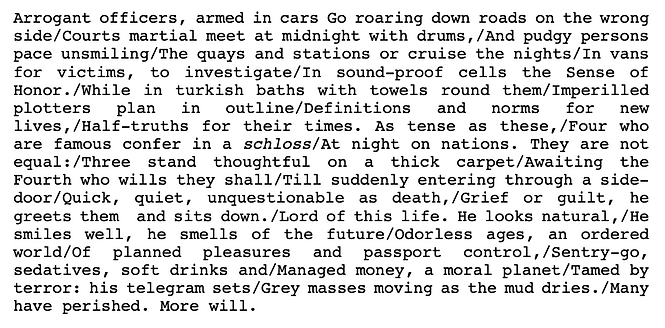
Auden coined “the age of anxiety” to describe the 1930s and buildup up to what would become World War II. The phrase was the title of a book-length poem that became his most famous work:
In 1937 during the Spanish Civil War, Auden left England to volunteer for the Spanish republic and was put to use writing pamphlets and propaganda. He left after only two months and stopped writing with overtly political themes.
In 1939, he and writer Christopher Isherwood, both disillusioned with politics, sailed to New York. Auden met the poet Chester Allman there; they became lovers, though Allman eventually left him Auden due to his inability to stay monogamous. Auden, inspired by his breakup, the death of his mother, the Lutheran ideals of social justice, and Kierkegaard, reconverted to Christianity. His poetry took on the added layer of defining and examining sin, though he believed humans to be inherently good and justice and equality to one day be realized. He was primarily inspired by German protestant Dietrich Bonhoeffer, who believed religion should focus on human suffering and not on fantastical elements.
After fellow “Oxford Group” member Louis MacNeice died in 1963, Auden wrote “The Cave of Making (The Poet’s Study)”. In it, he combines many of his most famous themes of science, morality, the use of poetry, and religion. He claims he wants to “bear witness / to the Truth” and questions how sin has affected his work:e “God may reduce you on Judgement Day to tears of shame reciting by heart the poems you would have written had your life been good.” Though his political work remains some of his most famous, his poetry interrogates how humanity can be studied and aided from a variety of methods and sources.
George Hegel
1770-1831
among the West's most influential philosophers
Philosophical Tenets
-
We do not directly perceive a physical world, but that our world is composed of our thoughts, ideas, and perceptions of the physical (think of the Matrix or living in a virtual reality).
-
Our individual perception is shaped by the human collective consciousness (wider society, also known as the Spirit/ Mind) through the language, traditions and moral of our human society.
-
Human collective consciousness (the Spirit/Mind) can evolve in the same way an argument evolves.
-
First, there is a proposition or thesis about how the physical world is.
-
However, every thesis or proposition has an inherent flaw or contradiction so that there is a mixture of true and false information.
-
This thesis results in an antithesis, a refutation to the false information in the original thesis.
-
Eventually, a synthesis is reached that possesses elements of all of theses and antitheses previously proposed; the human collective consciousness regards this as the real truth.
-
-
Essentially, our society is made up not of the material world, but of the discourse of human logic over time.
-
The Union of Opposites: The existence of the answers to many of the questions about the universe and human nature depend on the coexistence of two other concepts that are fundamentally opposite to each other.
-
Finite and Infinite, Cause and Effect, Freedom and Necessity, Subjectivity and Objectivity, etc.
-
Soren Kierkegaard
1813-1855
among the West's most influential philosophers
Philosophical Tenets
Kierkegaard’s father was riddled with such guilt he was convinced all seven sons would die before they reached the age of Jesus upon his crucifixion. Five did. Soren Kierkegaard, a Danish philosopher, was one of two that survived, eventually earning the title “the father of existentialism.”
Kierkegaard’s version of existentialism meant to trust God in the face of uncertainty. He believed that humans were dependent on God and had no way to ascend themselves, but must be descended upon by God. Faith to Kierkegaard must be constantly reavowed and never chosen out of reason, but rather out of absurdity. It is absurd, Kierkegaard believed, that God could do what he deemed impossible and forgive human beings for sinning. The highest form of consciousness to Kierkegaard is God-consciousness, in which a human can know they’re a sinner but also feel worthy of God’s forgiveness. Though he knew not everyone would be able to accept that grace and wrote, “there is only one guilt that God cannot forgive, that of not willing to believe in his greatness!”.
German philosopher Hegel was at the time preaching about idealism and attempting to simplify Christianity. Kierkegaard did not believe in idealism, as he found reality to be the only thing that matters, with choice and commitment being some of the most important and riskiest parts of life. Furthermore, he said no system could explain all of human consciousness. He rejected Hegel and the modern idea of Christianity, which Kierkegaard saw as playing at religion but not actually believing. Kierkegaard thought his role was then to “make Christianity difficult” and believed that the public should create their own opinions and think for themselves, as he thought truth to be individual and only real when one commits fully. He began using irony and humor to write parodies of Hegel and other ideas under several pseudonyms, all of which contradicted each other. He hoped this would confuse the public and allow them to make up their own minds.
He also continued publishing under his own name. While Kierkegaard believed all language to be idealized and therefore a representation of faith rather than what he thought of as real faith, he published many “Discourses at the Communion on Fridays” which resembled sermons and indicated his true feelings on forgiveness and God, meant to be read by a Christian who agreed with him rather than Christendom as a whole.
Helen Keller
1880 - 1968
At 19 months, Helen Keller contracted an illness that left her deaf and blind. At six, Alexander Graham Bell recommended her to the Perkins School for the Blind, where Keller met her longtime companion Anne Sullivan, her governess and teacher for many years.
Keller quickly learned Braille at the Perkins School, and at the age of 11, wrote the short story “The Frost King” as a birthday present for the Director. He published it in the Perkins newsletter, which led to Keller being accused of plagiarism, and Sullivan of fraud. They left the school.

Keller was soon taught to speak by Sarah Fuller at the Horace Mann School for the Deaf. With her unique skills, Keller kept advancing in school, eventually graduating cum laude from Radcliffe College in 1904, a year after publishing The Story of My Life and Optimism, which both chronicle how she learned reading, writing, and speaking while deaf and blind. She continued writing essays and memoirs, and also became a traveling lecturer.
In 1920, Keller, Roger Nash Baldwin, and others cofounded the American Civil Liberties Union. Through this work as well as her other activism, Keller helped to change the stigma against the deaf and blind and played a pivotal role in getting the disabled released from asylums. Though unusual, Keller’s story continues to inspire and has been dramatized many times through works such as the 1919 film "Deliverance" and 1960 Pulitzer Prize-winning play The Miracle Worker by William Gibson (and later the 1962 Oscar-winning film).
Mary Chapin Carpenter
1958 -
Mary Chapin Carpenter has earned a reputation for defying the country genre, and saying herself that she instead considers herself a singer-songwriter or country/folk/rocker. After releasing her first album "Hometown Hero" in 1987 to mild fanfare, Carpenter supplanted herself as a face of the industry with her booming success in 1990 with her album "Shooting Straight in the Dark." Many of her early chart-toppers such as “Down at the Twist and Shout” from the aforementioned album and “He Thinks He’ll Keep Her” from her next album "Come On Come On" were based on love and relationships, though as her career progressed, so did her message.
Carpenter’s songs took a political lean in the 2000s, especially with her album The Calling that had religious undertones, but also dealt with the state of American society and political authority. One of the most famous songs from that album, “Houston” looks at the aftermath of Hurricane Katrina. Her work is known for being open, honest, feminist, and not shying away from her beliefs. And though the topics Carpenter writes about are occasionally dark, her underlying ideals promote hope, faith, and optimism.
Suicide during the Civil War
The play suggests Judge Littlefield took his life during the Battle of Allatoona, as a soldier for the losing Confederate army. (See "Allatoon" above).
Suicide was rare during the Civil War. There are no recorded statistics for the Confederacy, but no more than 0.02% of Union soldiers took their own lives. There were two predominant factors that played into such consideration. First, soldiers in both armies were fearful of how they would be treated as a prisoner of war. Secondly, soldiers were well aware of the extraordinary suffering that accompanied battlefield injuries cause by gunshots, stabbings, artillery shrapnel, and cannonballs. Amputations without anesthesia were common sights and sounds in makeshift tent hospitals.